“Made with imported raw materials” is one of the most common claims in the professional lash adhesive market.
But for a serious lash brand, the word imported should not be accepted as proof of quality by itself.
A professional buyer should ask two different questions:
Where does the raw material actually come from?
and
Can the supplier connect that raw material to the product being manufactured for my order?
This is where documentation and traceability matter.
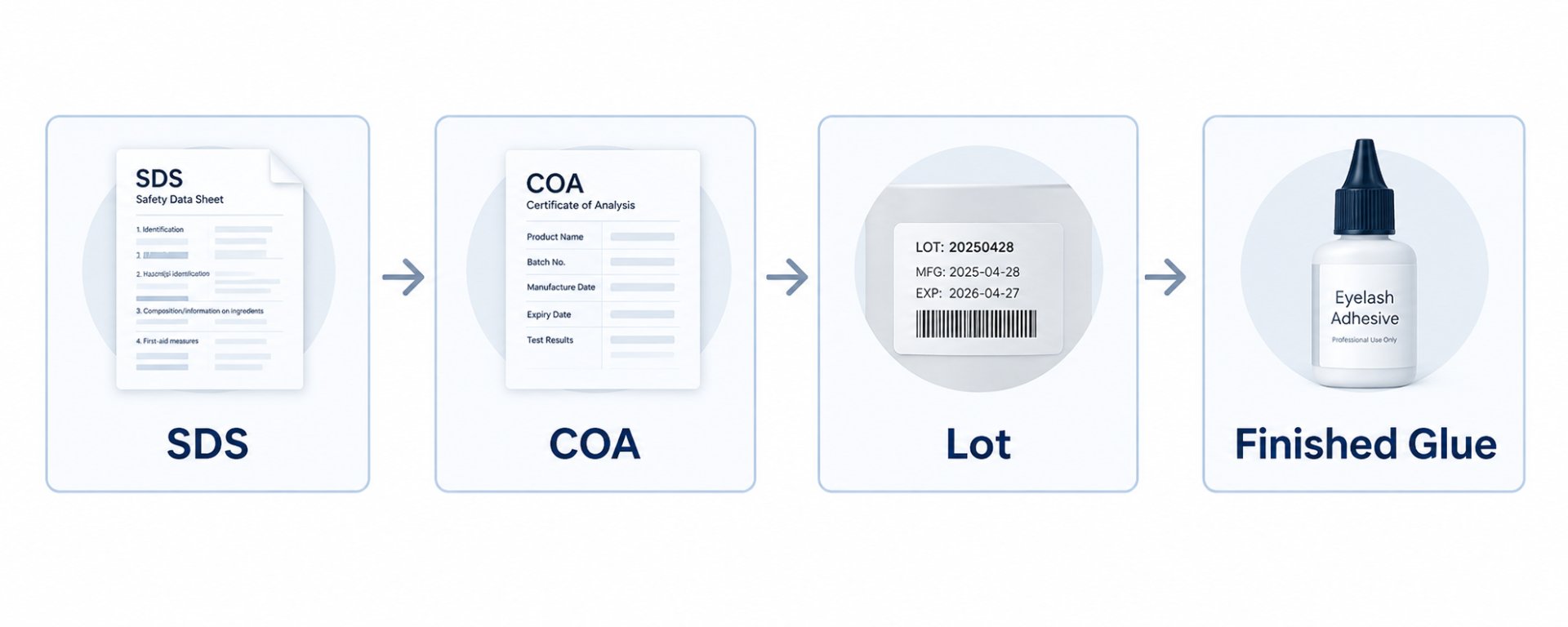
A supplier should be able to identify the source of a claimed imported material at an appropriate level for the commercial project.
Useful information may include:
Raw-material manufacturer
Supplier
Country of origin
Material name or grade
Applicable technical documentation
A statement such as:
“This is imported material.”
is weaker than traceable documentation.
An SDS — Safety Data Sheet — is primarily a chemical safety and hazard communication document.
It normally contains information such as:
Product identification
Manufacturer or responsible party
Composition information
Hazard information
Handling and storage
Physical and chemical properties
An SDS is important.
But there is an important limitation:
An SDS alone does not prove that the material used in your specific finished-glue batch was imported.
A copied PDF can describe a material without proving that the factory purchased and used that material in your order.
A COA — Certificate of Analysis — can provide batch-specific analytical information for a material or product.
For procurement verification, check whether the COA information is consistent with:
The material supplier
Product or material name
Lot or batch number
Production or test date
Relevant specification
The stronger question is not:
“Do you have a COA?”
It is:
“Can this COA be connected to the material actually used for my production?”
For a buyer who needs stronger verification, supporting sourcing records may provide an additional layer of evidence.
Depending on the supply chain, these may include applicable:
Supplier invoices
Purchase records
Import documentation
Packing information
Lot records
Warehouse receiving records
Not every document should necessarily be published publicly.
For B2B due diligence, however, the supplier should understand the difference between a marketing claim and a traceable sourcing claim.
This is the strongest part of the process.
The ideal traceability chain looks like:
Raw-material manufacturer
→
Raw-material lot
→
Factory purchasing or receiving record
→
Production batch
→
Finished adhesive
A supplier that can maintain this connection offers more useful evidence than a supplier that only sends a generic SDS.
Imported origin and product quality are not the same thing.
A raw material should be evaluated according to its specification, suitability, consistency, documentation and how it performs in the final formulation.
Therefore, a responsible supplier should avoid claiming that a material is superior simply because it is imported.
For professional buyers, **verified and suitable** is more meaningful than an unsupported country-of-origin claim.
No. An SDS identifies and communicates information about a chemical or product, but by itself it does not prove that a specific production batch used imported material.
A COA can provide batch-specific information, but buyers should still check whether the document can be connected to the material actually used in production.
A traceable chain connecting the raw-material source, material lot, purchasing or receiving documentation and finished production batch provides stronger evidence.
No. Origin alone does not determine quality. Specification, consistency, suitability, testing and final formulation all matter.
Applicable documentation can be discussed according to the selected adhesive project and available supply-chain records.
A serious private label project should verify the product first and design the marketing claims second.
If imported raw materials are important to your lash brand, tell Ethan what evidence your business requires before production.