395 nm and 405 nm are two of the most frequently discussed wavelengths in light-curing lash systems.
It is tempting to ask:
“Which wavelength is better?”
But for a professional lash brand, that question is incomplete.
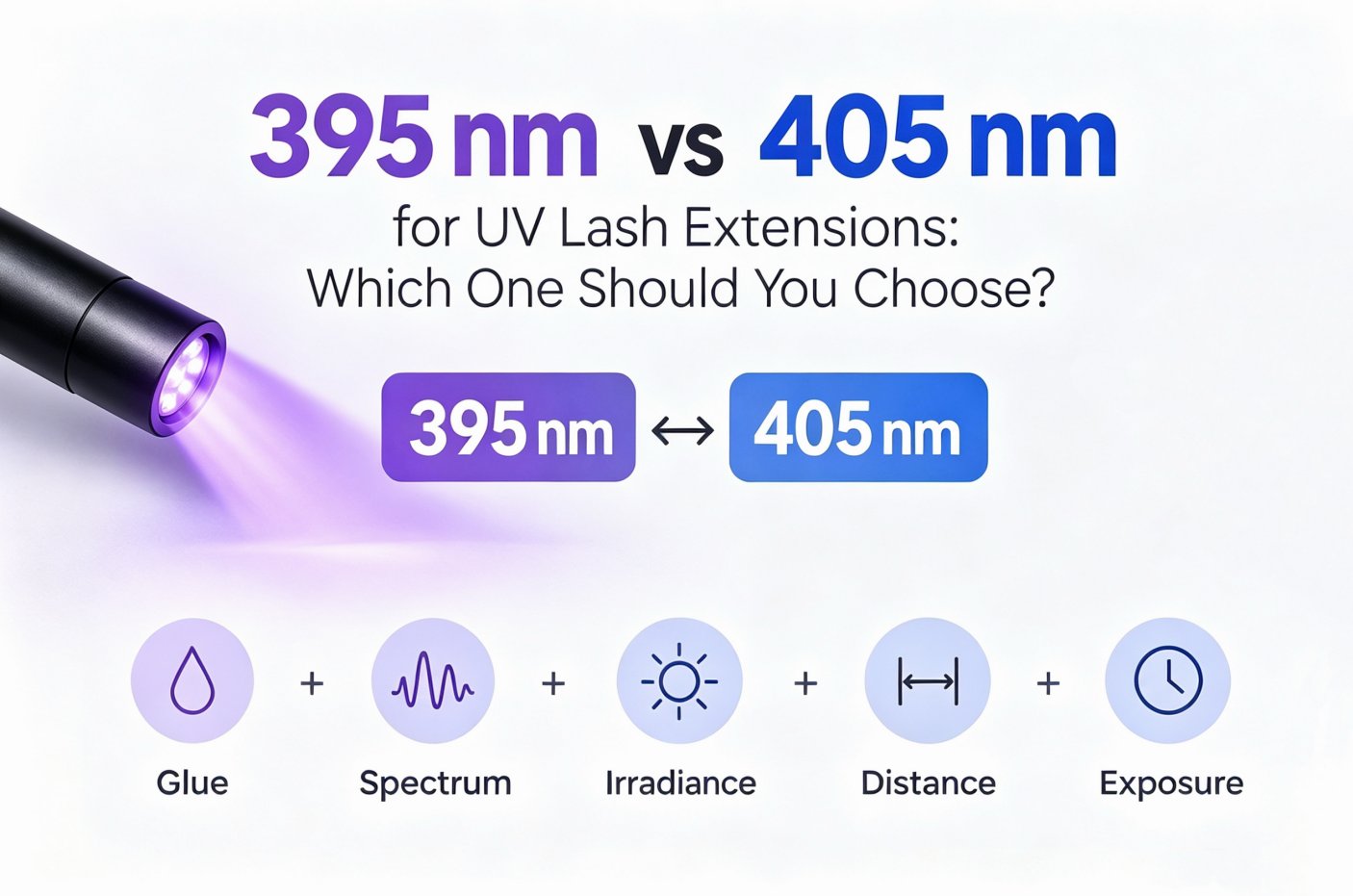
A curing system depends on more than one number.
The adhesive formulation, light spectrum, optical intensity, working distance, exposure time and safety evaluation all contribute to how the system should be assessed.
The better rule is:
Do not buy a wavelength. Buy a compatible, documented curing system.
Both wavelengths sit close to the boundary between ultraviolet and visible light.
395 nm is near the UVA/visible boundary.
405 nm is generally in the visible violet region.
However, a real lamp is not fully described by its advertised peak wavelength.
Professional buyers should ask whether the supplier can provide information about the lamp's spectral distribution rather than relying only on “395 nm” or “405 nm” printed in a listing.
Light-curing adhesive contains a light-sensitive curing system.
The lamp needs to provide appropriate optical energy for that adhesive.
This means:
A 405 nm lamp is not automatically better simply because the number is higher.
and
A 395 nm lamp is not automatically stronger or more effective simply because it is labelled UV.
The relevant question is whether the adhesive and lamp were designed or verified to work together under the intended application conditions.
When comparing lash curing lamps, professional buyers should consider at least:
Peak Wavelength
Where the lamp's optical output reaches its primary peak.
Spectral Distribution
The broader wavelengths emitted around the peak.
Irradiance
The amount of optical power reaching a defined area.
Working Distance
The distance between the light source and the curing area affects the exposure conditions.
Exposure Time
The amount of time the adhesive is illuminated.
Adhesive Compatibility
The glue's curing system must respond appropriately to the lamp.
405 nm being within visible violet light does not automatically create a universal safety conclusion.
Photobiological safety depends on actual exposure, spectrum and operating conditions.
Predominantly visible optical sources can still require evaluation for relevant photobiological hazards.
Likewise, UV-emitting products require appropriate UV-related assessment.
Therefore:
Wavelength classification is not the same thing as a complete safety assessment.
For a professional buyer, a useful evidence package can include:
1. Actual lamp specification
2. Spectral measurement
3. Peak wavelength
4. Irradiance measured under defined conditions
5. Recommended working distance
6. Intended exposure time
7. Compatible adhesive information
8. Applicable IEC 62471 photobiological safety report
9. Relevant electrical compliance documentation for the target market
A supplier does not become more credible by displaying the largest number of certification logos.
The strongest documentation is the documentation that clearly applies to the exact product being sold.
The IEC 62471 family addresses photobiological safety of lamps and lamp systems.
For products primarily emitting ultraviolet radiation, IEC 62471-6 provides requirements specifically for UV lamp products.
For products primarily emitting visible radiation, visible-light photobiological evaluation is also relevant.
That is one reason a supplier should know what the lamp actually emits before describing the product as “UV,” “LED” or “white light.”
Before choosing a curing system, ask the supplier:
What is the measured spectrum?
What is the peak wavelength?
At what distance was irradiance measured?
Which adhesive is this lamp intended to cure?
What exposure time is recommended?
Is there an applicable photobiological safety test report?
Which exact model was tested?
If these questions cannot be answered, a buyer should be cautious about claims based only on lamp color or marketing terminology.
Not universally. The correct choice depends on the adhesive and the complete curing system.
405 nm itself is generally within visible violet light, but a complete lamp should be evaluated using its actual spectral output rather than a single advertised number.
A wavelength number alone is not enough to establish complete photobiological safety. Spectrum, intensity, exposure and applicable testing matter.
Light-curing adhesives depend on appropriate optical exposure to initiate curing. Lamp and adhesive compatibility should therefore be confirmed.
Irradiance describes optical power delivered to a defined area. It is one of the factors that helps characterize the exposure produced by a curing lamp.
IEC 62471 is an international framework for evaluating the photobiological safety of lamps and lamp systems.
Yes. Buyers can discuss applicable UV adhesive and UV lash lamp sourcing as one project.
When you source a professional UV lash system, do not evaluate the glue, lamp and documentation separately.
Send Ethan the products you are considering and the market you plan to sell in.