Professional lash adhesive buyers may receive many different documents:
SDS
COA
laboratory test reports
raw-material documents
compliance documents
and
certificates.
These documents do not all prove the same thing.
A professional sourcing process should ask:
What does this document actually demonstrate?
Which sample or product does it apply to?
Can it be connected to the adhesive being purchased?
This distinction becomes especially important when a private label brand wants to print safety, material or performance claims on its packaging.
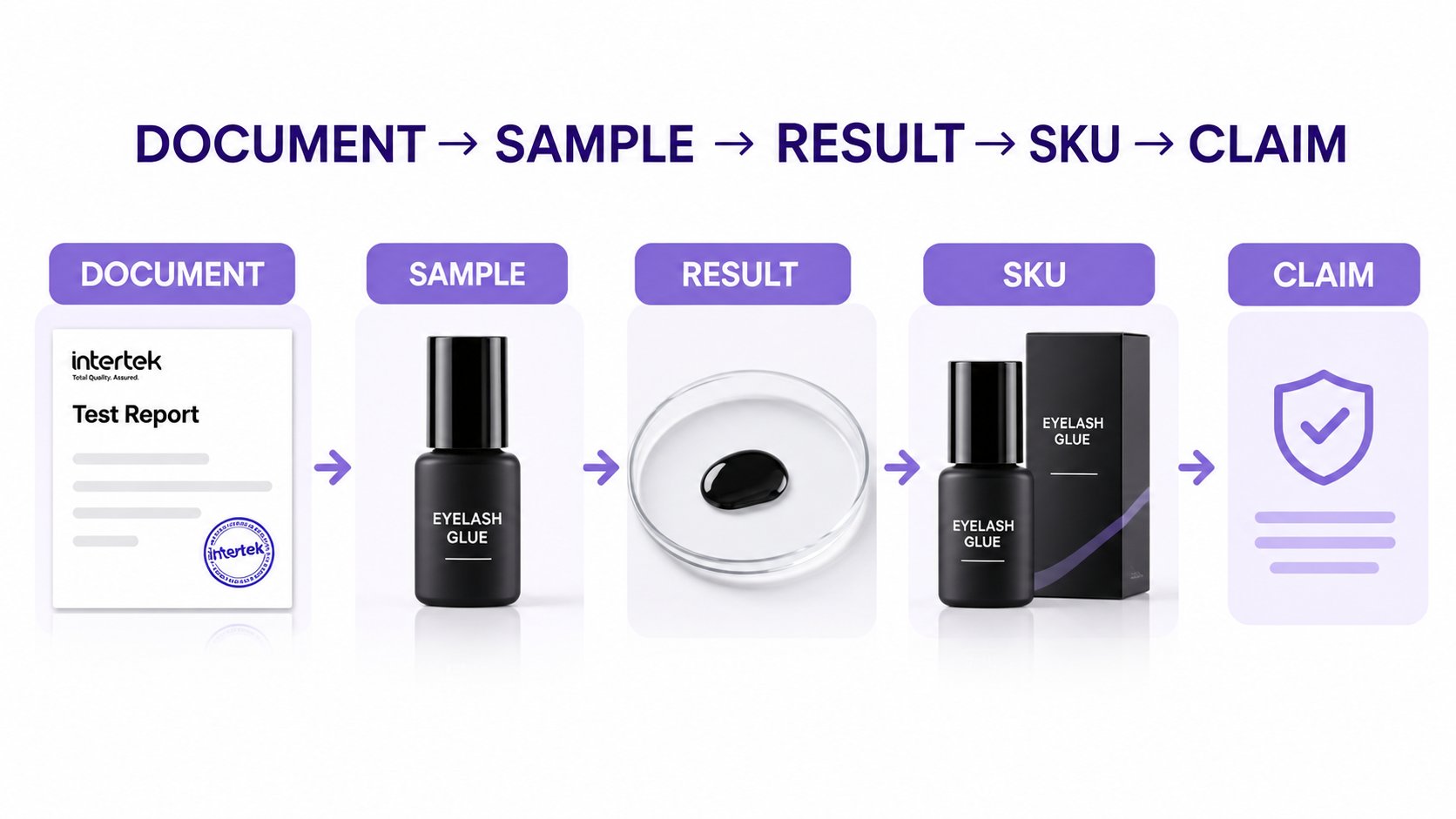
Before reviewing a document, identify the adhesive.
Useful identifiers can include:
- product name
- formula direction
- SKU
- sample description
- batch or lot information where applicable
A report for one adhesive sample should not automatically be applied to every formula in a supplier's catalog.
A Safety Data Sheet communicates information related to chemical identification, hazards, handling, storage and other safety information.
An SDS is important documentation.
But it is not the same thing as a laboratory report proving every possible product claim.
Likewise, an SDS for a raw material does not by itself prove that the material was used in a particular finished adhesive batch.
A laboratory test report records testing performed on a submitted sample.
Professional buyers should look for:
- laboratory
- report number
- sample description
- test item
- test method
- reporting or detection limit where applicable
- result
- conclusion where provided
- report date
The result should be interpreted within the scope of the test that was actually performed.
Laboratory reports may use N.D., commonly meaning Not Detected under the stated analytical conditions and reporting or detection limit.
This should not automatically be rewritten as:
“absolute zero”
or
“the substance can never be present.”
The more accurate statement follows the actual laboratory result and method.
A Certificate of Analysis can provide analytical information associated with a material or batch.
Depending on the product and supplier, it may include:
- material identification
- batch or lot number
- specification
- analytical result
- test date
A COA becomes more useful for sourcing when it can be connected to the material actually received and used.
If a lash adhesive is marketed using a raw-material origin claim, a professional buyer can ask how that claim is supported.
A useful evidence chain may include:
Raw-material manufacturer
→
Material lot
→
Purchasing / receiving record
→
Production batch
→
Finished adhesive
A generic raw-material document with no connection to production provides less traceability.
Allison has third-party laboratory documentation for applicable eyelash extension adhesive samples.
Current documentation includes testing performed on identified eyelash extension adhesive samples.
Specific results should only be connected to a particular Allison product after the tested sample has been matched to the applicable product or SKU.
This prevents a valid laboratory result from being applied more broadly than the report itself supports.
Once a test report is matched to the applicable product, evidence can be presented using a clear structure:
| Evidence Field | What Buyers Should See |
|---|---|
| Product / SKU | Exact applicable product |
| Laboratory | Organization performing the test |
| Sample Description | Description shown in the report |
| Test Item | What was actually tested |
| Test Method | Method shown in the report |
| Result | Actual laboratory result |
| Report Date | Date shown in the report |
| Report Reference | Applicable report identifier |
This is more useful than placing a laboratory logo on a page without explaining what was tested.
SDS
Communicates chemical and safety information.
Laboratory Test Report
Reports testing performed on a submitted sample.
COA
Can report analytical or specification information for a material or batch.
Certification
Represents a different conformity-assessment process and should not be used as a generic name for every technical document.
For B2B buyers, using the correct document name helps prevent misunderstanding.
If your lash brand requires specific documentation, discuss the requirement before packaging is finalized.
Tell Allison:
- the exact adhesive being considered
- destination country
- marketplace or distribution channel
- documentation requested
- claims you intend to place on the packaging
This allows the available evidence to be reviewed before the claim becomes part of the finished brand.
The strongest sourcing structure is:
Product
→
Applicable document
→
Tested sample or material
→
Result
→
Supported claim
The goal is not to collect the largest number of logos.
The goal is to understand what each document can actually support.
Not necessarily. An SDS and a laboratory test report serve different purposes.
N.D. generally means a substance was not detected under the stated analytical conditions and reporting or detection limit.
That should not be assumed.
Yes. Allison has third-party laboratory documentation for applicable eyelash extension adhesive samples.
Product-specific applicability should be confirmed by matching the tested sample to the exact Allison product before a specific result is published as a product claim.
Yes. Buyers should identify the product, target market and documentation requirements before production.
Not by itself. Raw-material origin and production use require additional traceability when that claim is important.
Applicable documentation can be reviewed according to the selected product and available evidence. Buyers should separately confirm the legal or regulatory requirements applicable to their destination market.
Verify the Evidence Before Printing the Claim
If testing, raw-material origin or documentation matters to your lash brand, discuss the exact product and target market before private label packaging is finalized.