A professional UV lash lamp should not be evaluated by light color or wattage alone.
For B2B buyers developing a light-curing lash system, useful technical questions include:
What wavelengths does the lamp emit?
What is the optical irradiance?
At what distance was it measured?
Which adhesive is it intended to cure?
What photobiological-safety evidence applies to the exact model?
These questions create a more useful sourcing discussion than simply asking whether a lamp is “white,” “purple” or “safe.”
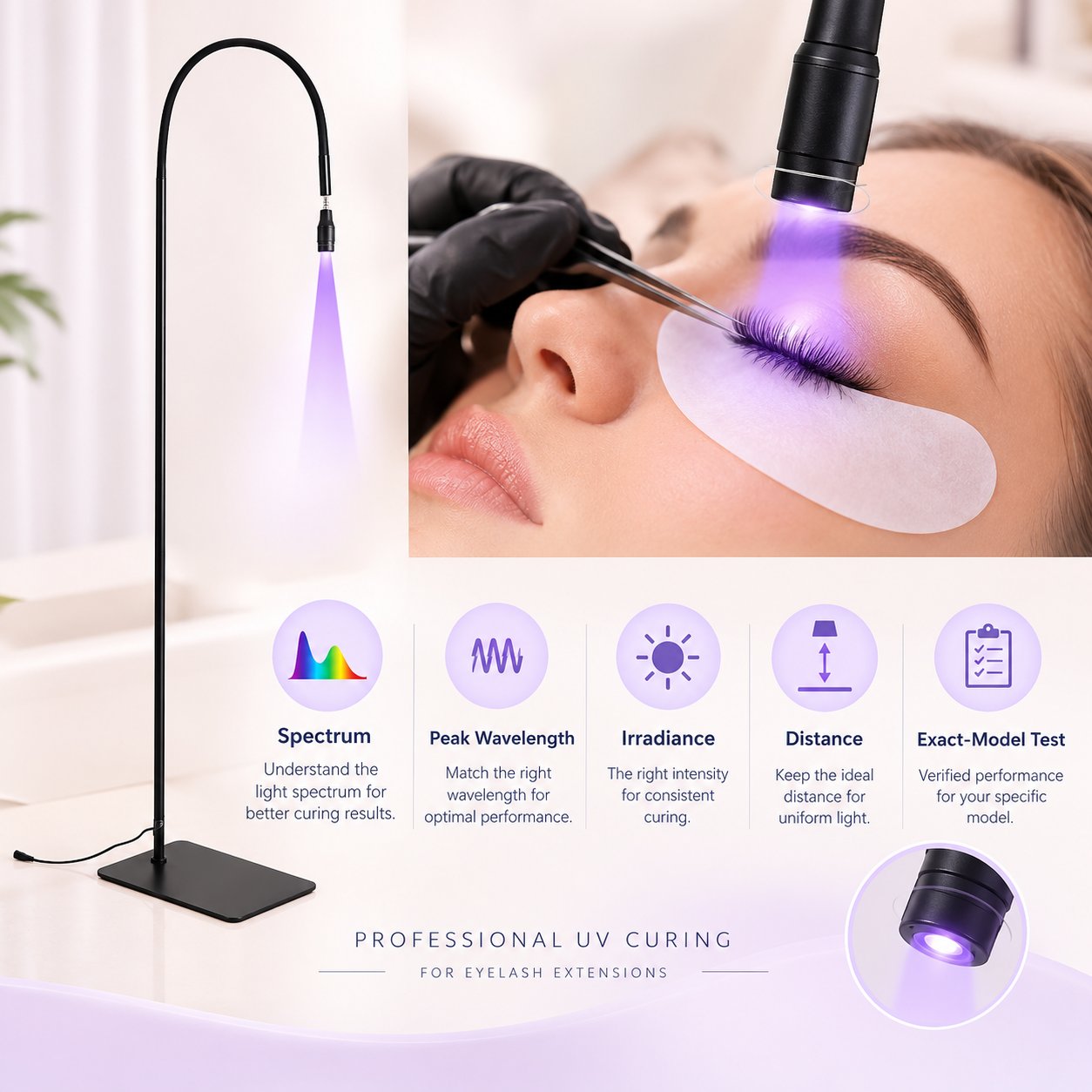
The visible appearance of a lamp is not a complete spectral measurement.
A lamp may be marketed as:
purple UV
UV LED
but a professional buyer should ask what optical output the exact lamp actually produces.
A measured spectrum provides more useful information than visual color alone.
A supplier may describe a lamp using one wavelength number.
That number may represent a nominal wavelength or a peak in the lamp's spectral output.
It should not automatically be interpreted as the lamp's complete spectrum.
Professional buyers can ask:
Is this a nominal wavelength, peak wavelength or measured range?
Irradiance describes optical power incident on an area and may be reported in units such as mW/cm².
It provides information that a wattage number on the power supply does not provide.
Electrical power and optical irradiance are not interchangeable specifications.
An irradiance value without measurement distance is incomplete information.
Distance changes the optical exposure at the working area.
The same principle matters when interpreting safety testing.
If a supplier provides a photobiological risk classification, ask:
At what distance and operating condition was the lamp evaluated?
The lamp is only one side of a light-curing lash system.
The adhesive contains the light-sensitive curing chemistry.
Professional buyers should therefore confirm that the lamp and adhesive are intended to work together.
Do not assume that every product called “UV glue” will behave identically under every UV or LED curing lamp.
Optical radiation can create different biological hazards depending on wavelength, intensity, exposure and use conditions.
IEC 62471 is a framework used for evaluating photobiological safety of lamps and lamp systems.
A professional buyer should distinguish between:
a generic safety statement
and
an applicable test report for the exact lamp model under defined conditions.
A report is most useful when the buyer can identify:
- the tested model
- the tested configuration
- the operating condition
- the measurement distance where relevant
- the resulting classification or findings
If internal optical components change, buyers should ask whether the existing report still represents the product being supplied.
A white-looking lamp should not automatically be described as:
UV-free
eye-safe
or
harmless.
Likewise, a purple-looking lamp should not automatically be treated as more dangerous simply because of its visible appearance.
The appropriate evaluation uses actual optical data and applicable safety assessment.
| Specification | Buyer Should Ask |
|---|---|
| Product Model | What exact model am I buying? |
| Spectrum | Is measured spectral data available? |
| Peak Wavelength | What is the measured or specified peak? |
| Irradiance | What value was measured? |
| Measurement Distance | At what distance? |
| Working Distance | What does the product instruction specify? |
| Adhesive Compatibility | Which adhesive is intended for this lamp? |
| Exposure Method | What operating instructions apply? |
| Photobiological Safety | What report applies to this exact model? |
| Electrical / Market Compliance | What documents apply to my destination market? |
Allison is currently organizing product-specific technical information for its UV lash curing-lamp sourcing projects.
Buyers with specific technical or compliance requirements should identify the destination market and required documentation before placing a private label or wholesale order.
Specific safety or performance claims should only be made when supported by documentation applicable to the exact product.
No. Electrical wattage and optical irradiance are different measurements.
A single wavelength label does not describe the complete spectrum.
No safety conclusion should be made from visible color alone.
Optical exposure at the working area depends in part on distance, so distance provides important context for irradiance and safety measurements.
IEC 62471 is an international framework used to evaluate photobiological hazards from lamps and lamp systems.
Allison should only make a product-specific statement after an applicable report for the exact supplied model has been verified.
For a professional light-curing system, discussing both products together can help address compatibility.
Send Ethan the lamp specification you are comparing, your target market and whether you also need UV adhesive.