The lash industry now uses several different names for light-curing systems:
UV lamp. UV LED. LED lamp. White LED. Purple UV. 395 nm. 405 nm.
These terms can make two products sound completely different even when part of their operating spectrum is relatively close.
For lash artists and B2B buyers, the visible color of the light is not enough information to determine how a curing system performs — or how its optical safety should be evaluated.
The better questions are:
What wavelengths does the lamp actually emit?
How much optical energy reaches the working area?
What adhesive is it designed to cure?
Has the lamp undergone appropriate photobiological safety evaluation?
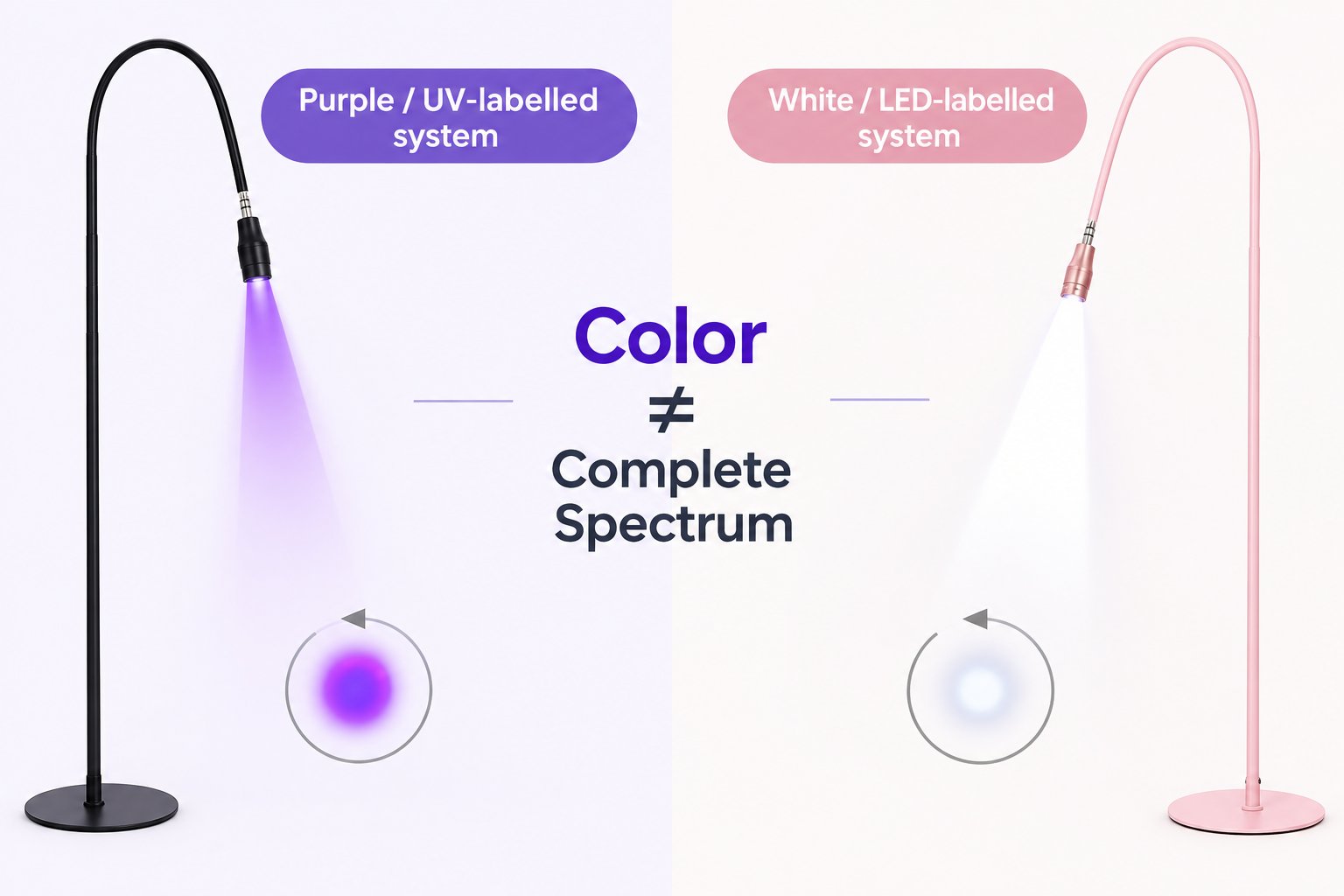
One of the most important things buyers should understand is that “white LED” is not a single standardized spectral specification in the lash market.
Different manufacturers use the term differently.
A product may be marketed as a white LED system while describing a specific wavelength near 405 nm.
Another system may describe a broader visible-light output.
Therefore, a buyer should not assume that two products called “white LED” emit identical light.
Ask for the actual spectral information.
Nanometers, abbreviated as nm, describe wavelength.
395 nm sits near the ultraviolet and visible-light boundary.
405 nm sits in the visible violet region under commonly used wavelength definitions.
But the number printed on a product page does not describe the entire output of a lamp.
Real light sources can have a spectral distribution around a peak wavelength.
For professional evaluation, a spectral measurement provides more information than the color seen by the human eye.
No.
The word white should not be used as a substitute for optical safety testing.
Visible light can also be assessed for photobiological hazards, including blue-light-related hazards, while UV-emitting products require evaluation of ultraviolet exposure.
The relevant question is not:
“Does the lamp look white or purple?”
It is:
“What radiation does the lamp emit under its actual operating conditions, and what does the applicable safety assessment show?”
IEC 62471 is an international standard used for evaluating the photobiological safety of lamps and lamp systems.
It considers optical radiation rather than marketing names.
For products primarily emitting ultraviolet radiation, more specific UV-product requirements may also apply.
For predominantly visible light sources, visible-light photobiological evaluation is also relevant.
For a professional lash brand sourcing a curing lamp, an applicable third-party photobiological safety report is much more meaningful than a package simply printed with the word “safe.”
| Marketing Claim | Better Question |
|---|---|
| White LED | What is the measured spectral output? |
| 395 nm | Is 395 nm the peak or the complete operating range? |
| 405 nm | What does the spectrum look like around the peak? |
| UV-Free | Is there a spectral report supporting that claim? |
| Safe Light | Is there an applicable photobiological safety test report? |
A curing lamp cannot be evaluated only as a lighting product.
It is part of a **lamp-and-adhesive curing system**.
The adhesive contains a light-sensitive curing system designed to respond to appropriate optical exposure.
If the adhesive and lamp are poorly matched, curing behavior can change.
That is why B2B buyers should ask the supplier to confirm lamp-and-adhesive compatibility rather than buying products based only on a wavelength printed in a listing.
405 nm is generally described within the visible violet region, while 395 nm lies close to the UV/visible boundary. A lamp's complete spectral output is more useful than one number when evaluating the product.
The term “white LED” alone does not prove that a product has zero ultraviolet output. Buyers should request spectral data when this claim matters.
Visible color alone is not sufficient to determine photobiological risk. Actual wavelength distribution, intensity, exposure conditions and safety testing matter.
IEC 62471 is an international framework for evaluating photobiological hazards from lamps and lamp systems.
Choose a curing system that is compatible with the adhesive being used and supported by appropriate product information and testing. Wavelength should not be the only purchasing criterion.
Yes. Buyers sourcing an applicable UV adhesive and curing lamp can discuss the complete system with Allison.
If you are sourcing a curing system for your lash brand, send Ethan the lamp or adhesive specifications you are currently considering.
Allison can help you identify the information that should be confirmed before sourcing.